
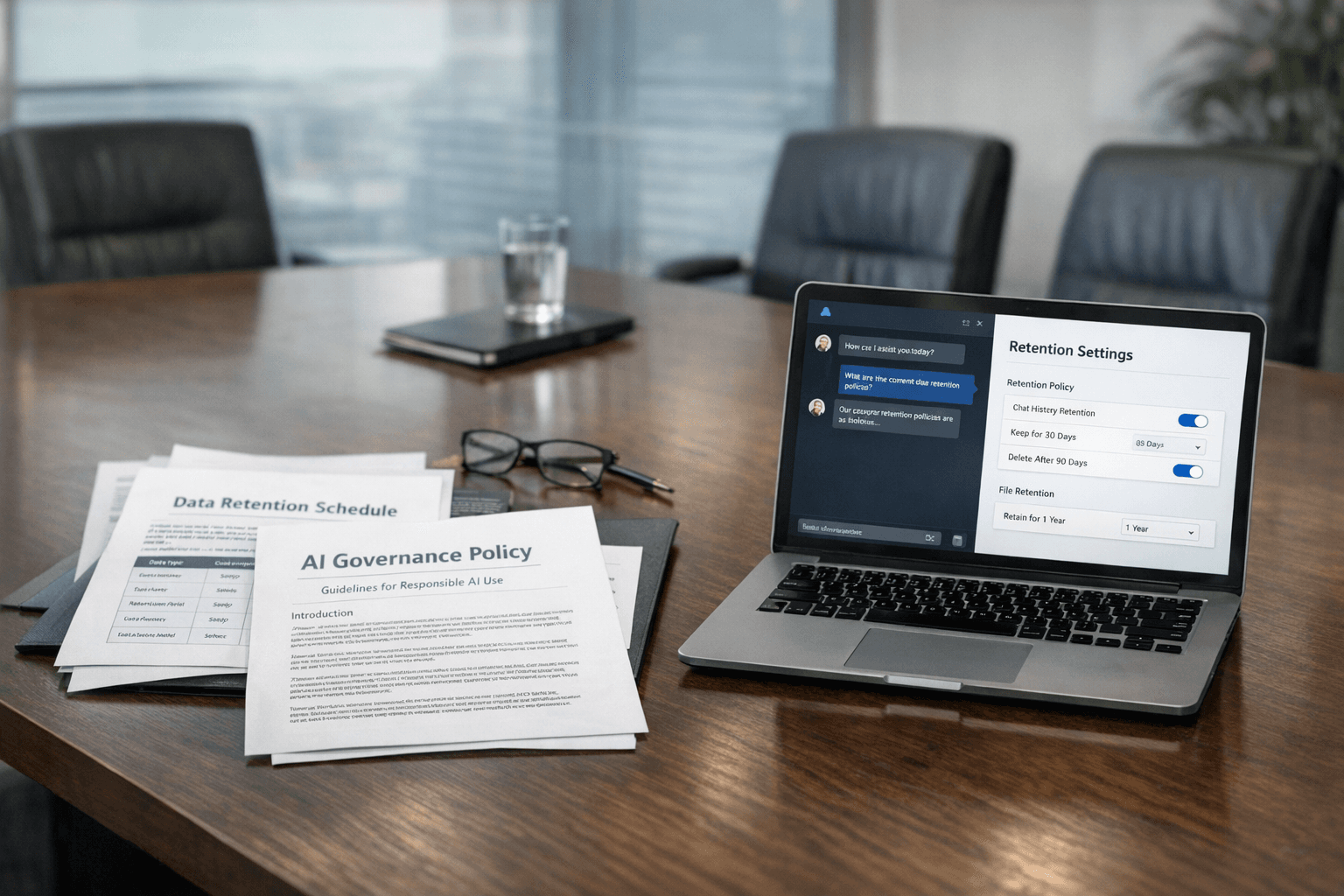
An AI data retention policy is one of the simplest controls to ask for and one of the easiest to find missing.
A company enables a chatbot, a meeting assistant, a coding copilot or an internal retrieval tool. Security reviews the vendor. Legal checks the contract. Procurement gets the deal done. Then 6 months later, someone asks a basic question: what exactly is being stored, where, and for how long? The answer is usually some version of “it depends on the feature”. That is not governance. That is drift.
The problem is not just that AI systems collect data. Plenty of enterprise systems do that. The issue is that AI products often create extra layers of persistence that teams do not track well: prompts, uploaded files, chat history, feedback signals, model tuning data, generated outputs, embeddings, logs, transcripts, and admin telemetry.
Different parts of that data may live in different places, under different retention schedules, with different deletion behavior. If you do not force clarity early, you end up retaining sensitive data longer than intended while assuming someone else owns the problem.
Why AI retention gets missed
Most companies already have records retention rules, privacy notices, and maybe even a deletion standard. But AI systems break the normal mental model.
A standard SaaS app usually has a straightforward purpose and data flow. A CRM stores customer records. An HR system stores employee data. Retention can be tied to the business record. AI tools are messier. They often sit across functions and ingest fragments of many record types without becoming the system of record for any of them.
Take an enterprise chatbot. Employees paste contract language, incident details, source code, customer complaints, board draft material, and M&A notes into the same interface. None of that means the chatbot should retain those inputs indefinitely. But without a specific AI data retention policy, the platform may keep prompts and outputs for default periods that nobody negotiated. Worse, different settings may apply to consumer accounts, enterprise workspaces, API traffic, and opt-in product improvement features.
That is where avoidable risk starts.
The real failure modes
The first failure mode is over-retention
Teams focus on preventing AI training on company data, which matters, but they ignore ordinary storage. A vendor can promise not to train on your inputs and still retain prompts, outputs, or logs for abuse monitoring, troubleshooting, analytics, or legal hold support. Those are not exotic edge cases. They are normal product operations.
Over-retention matters because AI tools attract sensitive content. People use them for convenience, especially under deadline. If your retention settings allow broad history by default, you are building a searchable archive of exactly the material you would prefer to minimize.
The second failure mode is undeletable copies
A user deletes a chat, but the transcript remains in admin logs, backups, exported analytics, connected storage, or downstream ticketing systems. A generated summary may be saved in a document repository. An uploaded file may remain linked to a workspace after the conversation is gone. If your policy only addresses the visible interface, it is not a policy. It is user theater.
The third failure mode is retention mismatch
Legal may want to preserve certain communications. Privacy may want to minimize personal data. Security may want detailed logs for incident response. Business teams may want AI history retained for productivity. All of those are legitimate interests, but they cannot be solved with a single blanket period. If you leave those conflicts unresolved, the vendor default becomes your operating model.
The fourth failure mode is hidden data reuse
Even when data is not used for model training, it may still be used for feature improvement, trust and safety review, quality assurance, or human support. Those uses may be appropriate, but they change the risk profile. A retention decision is inseparable from an access decision.
Why executives should care
This is not an abstract hygiene issue. It hits 4 places executives already care about.
-
First, litigation and investigations. If AI prompts and outputs are retained broadly, they become discoverable material. That can include half-formed strategy discussions, regulatory analysis, product defect triage, and employee commentary that never would have existed in a durable system before. Convenience creates records.
-
Second, privacy exposure. Employees routinely paste personal data into AI tools without thinking much about it. If the tool retains those interactions beyond necessity, data minimization claims start looking weak. This gets worse when regional deletion rights apply and no one can explain where AI-generated or AI-adjacent data lives.
-
Third, insider risk. Long-lived AI histories are useful to users and equally useful to anyone with a compromised account, excessive admin privileges, or access to a stale export. Searchable memory is productive right up until it is not.
-
Fourth, operating confusion. When business teams assume chats disappear and compliance teams assume they are archived, both are wrong in different ways. That gap is where governance fails.
What a practical AI data retention policy should cover
Keep it operational. The goal is not a perfect taxonomy. The goal is to force explicit decisions.
Start by separating data types. At minimum, define retention expectations for prompts, uploaded files, generated outputs, conversation history, system logs, feedback submissions, and any data used for product improvement or model customization. Treat these as distinct classes. They often have different storage paths and deletion mechanics.
Next, map retention by deployment model. Browser use of a hosted chatbot, sanctioned enterprise workspace use, API integration, and internal AI applications are not the same thing. A policy that says “AI interactions are retained for 30 days” sounds neat and usually means nothing once engineering starts building connectors.
Then require three specific answers from every AI owner or vendor:
-
What data is stored by default?
-
What can be configured?
-
What cannot be deleted on demand, including backups and logs?
If a vendor cannot answer those clearly, you have learned something useful.
You also need a decision on memory features. Persistent chat history, cross-session memory, retrieval indexes, and personalized assistants all extend data life in ways users do not intuitively understand. Make teams justify why those features need to be on. “Better experience” is not enough when the tradeoff is durable retention of sensitive material.
For internal use cases, set input rules that match retention reality. If a system keeps prompts for debugging, do not allow unrestricted entry of regulated or highly sensitive data into that system. Controls should reflect how the product actually behaves, not how people wish it behaved.
Finally, align retention with offboarding, legal hold, and incident response. If an employee leaves, what happens to their AI chat history? If legal issues a preservation notice, can relevant AI interactions be preserved without freezing everything forever? If security investigates a data leak, are AI logs available long enough to be useful but not so long that they become a liability? These are ordinary governance questions. AI does not remove them. It just makes sloppy answers more expensive.
A simple operating model
One practical model is this:
Use the shortest default retention that still supports security and operational needs. Disable optional product improvement uses unless there is a reviewed reason to allow them. Restrict persistent memory and long-term chat history to approved use cases. Apply stricter retention and input rules to tools likely to receive legal, customer, employee, or source code data. Review vendor settings quarterly because these products change fast and often quietly.
Most importantly, make one team accountable for the control. Shared ownership sounds mature and usually produces gaps. Security, privacy, legal, and records management all have a stake here, but someone needs to own the actual retention standard and exceptions process.
The takeaway
An AI data retention policy is not paperwork for the compliance shelf. It is the difference between using AI as a tool and accidentally turning it into an unmanaged archive.
The companies that handle this well are not doing anything dramatic. They are asking boring, specific questions early: what is stored, how long, who can access it, and what really gets deleted? That discipline prevents a lot of future cleanup.
If your enterprise AI program does not have a clear answer yet, this is a good place to start. Not because it is fashionable. Because retained data has a way of becoming important at exactly the wrong time.