
By the time security becomes visible inside a company, it is often already losing.
Not because the risks are imaginary. Not because the controls are optional. And not because the people involved are careless.
It is losing because security tends to arrive wrapped in friction.
A delayed launch. A dense questionnaire. A vague risk escalation. A meeting with too many people. A policy nobody can operationalize. A leader asking for “alignment” when what the team really needs is a decision.
That pattern is what this series has been about.
Over the last quarter, we have written about why security turns into drama, why decisions get delayed, why incident plans don’t save you, why compliance snapshots get confused for security maturity, why vendor reviews become painful, why SOC 2 gets misunderstood, why hiring a CISO too early or too late causes different problems, why advice and execution get mixed together, why security decisions don’t belong in meetings and why calm security beats perfect security.
This final piece is meant to tie those threads together.
Not as a recap. As a position.
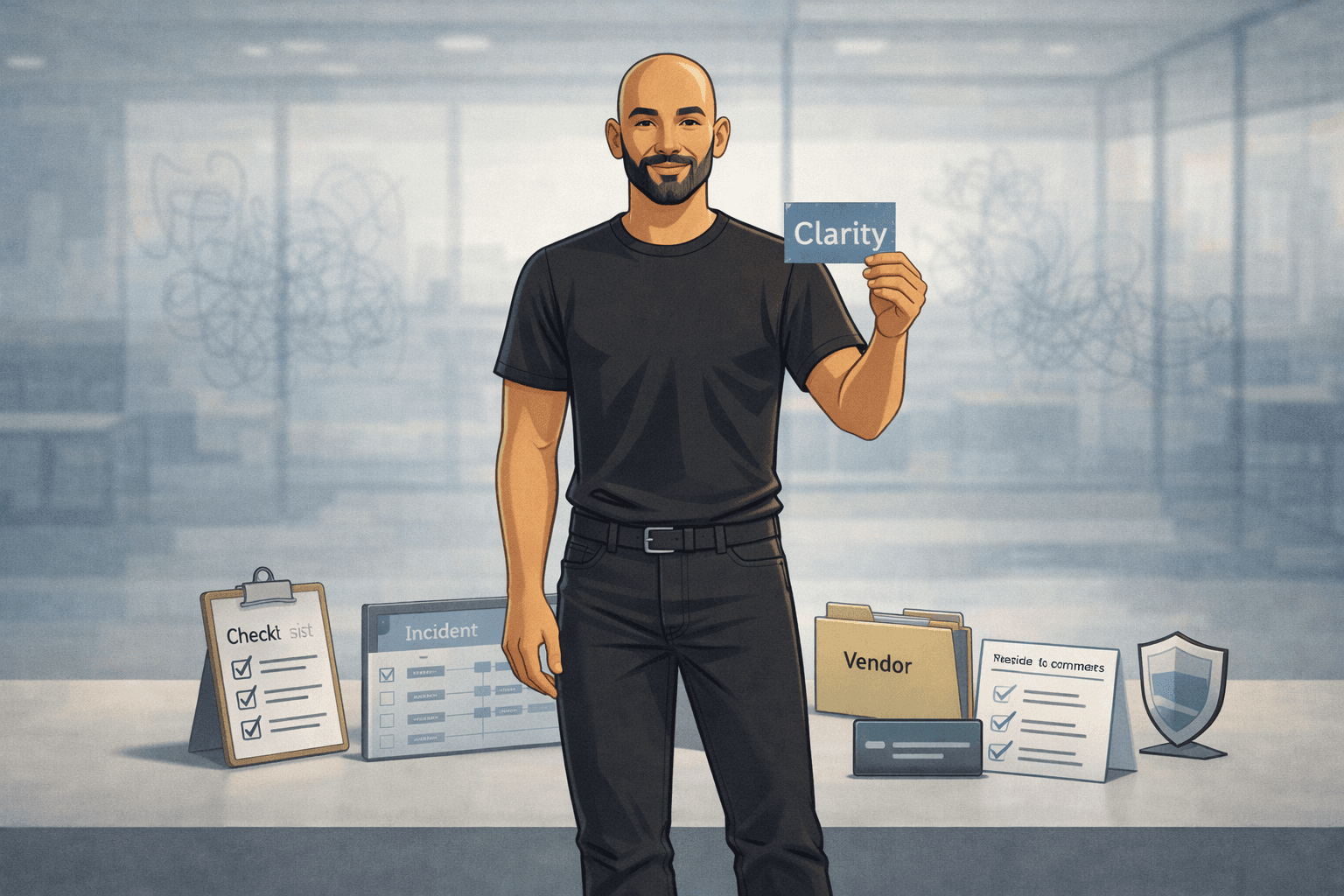
Because “Security, Minus the Drama” is not just a tagline. It is a way of operating. It is a bias toward clarity over theater, usefulness over posturing, and calm execution over security as performance.
If we had to reduce the whole philosophy into one sentence, it would be this:
Security works better when it is designed to help people make clear decisions under real-world constraints.
That sounds obvious. It is not how most security functions behave.
Where the drama actually comes from
Security drama usually gets blamed on the wrong things.
People blame regulations. They blame customers. They blame auditors. They blame engineering culture. They blame immature leadership.
Those factors are real. But they are not usually the root problem.
The root problem is that security is often structured in a way that creates unnecessary ambiguity.
Ambiguity around:
-
Who decides
-
What matters most
-
What “good enough” looks like
-
Whether the team is giving advice or doing execution
-
Whether a meeting is for discovery or approval
-
Whether a control is real or seasonal
-
Whether a vendor is high risk or just inconvenient
-
Whether readiness means perfect planning or practical response
Once ambiguity enters the system, organizations compensate with activity.
More meetings. More templates. More workstreams. More approvals. More language. More artifacts.
That activity looks responsible from a distance. Up close, it often functions as a substitute for clarity.
And that is how security becomes drama: not because the stakes are low, but because the operating model makes everything feel harder than it needs to be.
The quiet alternative: clarity, then structure, then action
The philosophy behind Zero Drama Security is simple on purpose.
- Name the real question
A surprising amount of security dysfunction disappears once the actual question is written down.
Not:
-
“We should improve vendor risk”
-
“We need to align on this launch”
-
“Can security take a look?”
-
“Maybe we should bring in a CISO”
But:
-
“Can we use this vendor by next Friday with acceptable risk?”
-
“Can this feature launch with these conditions?”
-
“What is the minimum viable control set for this quarter?”
-
“Do we need a full-time CISO, or do we need security leadership outcomes?”
When the question is vague, the work expands. When the question is clear, the work becomes manageable.
That is why earlier in the series we pushed so hard on Answer Briefs, written recommendations and decision-first operating models. Security improves when the organization is forced to say what decision it is actually trying to make.
- Separate advice from execution
This is one of the most useful distinctions in modern security work.
Advice is a recommendation. Execution is implementation.
Advice tells you what you should do and why. Execution makes it real.
A lot of security frustration comes from mixing the two. The business asks for clarity and gets a backlog. Or security is asked to “help” and ends up dragged into implementation with no authority over the underlying decision.
That is not just inefficient. It creates resentment on both sides.
A mature security function knows which lane it is in:
-
Are we here to advise?
-
Are we here to build?
-
Are we here to operate?
-
Are we here to approve?
-
Are we here to assess?
The more clearly those lanes are separated, the calmer the function becomes.
- Build for reality, not performance
This theme showed up in almost every article.
A vendor review should not be a paperwork ritual. A SOC 2 report should not be treated like a shield. A CISO hire should not be used as an optics move. An incident plan should not be so polished that nobody can use it. A meeting should not be the place where first-pass thinking happens.
In each case, the problem is the same: the security artifact is being optimized for appearance rather than use.
Security, minus the drama, means designing things that still work on a normal Tuesday when people are busy, the facts are incomplete and nobody has time for a ceremony.
That is where maturity lives.
What this looks like in practice
This philosophy is not abstract. It shows up in very specific choices.
Vendor risk
The dramatic version:
-
Every vendor gets a long review
-
Intake is vague
-
Security collects documents until people get angry
-
No one knows when a decision will happen
The calmer version:
-
Short intake
-
Risk tiering
-
Evidence packs by tier
-
Explicit decision owner
-
Clear SLAs
-
Compensating controls when needed
Same domain. Very different experience.
SOC 2
The dramatic version:
-
“We passed, so we’re secure”
-
Evidence assembled seasonally
-
Scope misunderstood
-
Customer trust outsourced to a report
The calmer version:
-
Clear scope narrative
-
Exceptions taken seriously
-
Controls designed to operate all year
-
SOC 2 treated as a useful signal, not a magic trick
Incident response
The dramatic version:
-
Sprawling plan
-
Live confusion
-
Too many people
-
Communications improvised
-
Slow containment because certainty is missing
The calmer version:
-
One owner
-
First hour guide
-
Clear workstreams
-
Short factual updates
-
Decisions made with tradeoffs, not fantasy certainty
Security leadership
The dramatic version:
-
Hire a CISO because the board expects one
-
No leverage, no scope clarity, no real sponsorship
-
Title first, outcomes later
The calmer version:
-
Define the problem first
-
Choose fractional, builder, or full executive based on complexity and exposure
-
Align resources to outcomes
-
Make leadership useful before making it impressive
This is what “minus the drama” means. It is not softer security. It is more practical security.
The principles underneath the brand
If we had to write the Zero Drama Security operating principles plainly, they would be these.
Clarity beats volume
More artifacts do not equal better security. A crisp recommendation is often worth more than a thick deck.
Decisions beat meetings
Meetings should refine or finalize decisions, not host the first version of thinking.
Boring beats impressive
The best controls are the ones that operate quietly and consistently, not the ones that look sophisticated in a slide.
Risk beats ritual
If a task is not changing a decision, reducing exposure, or improving response, it may just be security theater.
Calm beats perfect
Perfect-security thinking makes teams brittle. Calm teams move, communicate, and adapt.
Real operations beat compliance aesthetics
Compliance matters. But controls that only exist for audits are costumes, not capabilities.
Explicit tradeoffs beat hidden drift
Security decisions always involve tradeoffs. Good teams state them openly instead of pretending there is a zero-cost answer.
These principles are not anti-security. They are anti-performance.
And in practice, that often makes them more demanding than the dramatic version. It is easier to hide behind process than to write a recommendation, own a tradeoff, and stand behind it.
Why this matters now
Modern work has made the old security style less viable.
Teams are distributed. Product cycles are faster. Vendors multiply quickly. AI changes architectures and expectations. Executives have less patience for vague caution. Customers still want assurance. Regulators still want evidence. Incidents still happen on inconvenient days.
In that environment, security cannot afford to be a ceremony-heavy function that confuses seriousness with complexity.
It has to be sharper than that.
It has to:
-
Help leaders decide quickly
-
Help teams implement sanely
-
Help the business move without pretending risk disappears
-
Help the organization stay functional under pressure
That is why we believe so strongly in calm security. Not because calm sounds nice. Because calm is efficient. Calm scales. Calm makes better decisions. Calm reduces secondary damage.
Drama burns time. Drama burns trust. Drama burns political capital. And it usually shows up right when the organization can least afford it.
What clients usually need (even when they ask for something else)
One of the reasons we built Zero Drama Security this way is that clients rarely show up asking for the real thing directly.
They ask for:
-
A policy pack
-
A SOC 2 gap scan
-
A vendor review refresh
-
A tabletop
-
A fractional CISO
-
A privacy readiness check
-
An AWS assessment
Those are valid asks. But underneath them, the pattern is often the same.
They need:
-
Someone to cut through noise
-
Someone to define the actual problem
-
Someone to make the security work proportionate
-
Someone to separate what is urgent from what is performative
-
Someone to help them act without turning everything into a project
That is the work we care about most.
Not because strategy is more interesting than implementation. It isn’t. Good implementation matters. But implementation works better when the organization is not confused about what it is trying to accomplish.
This is the manifesto
So here it is, plainly:
Security, Minus the Drama means:
-
No fear-based posture
-
No unnecessary theater
-
No oversized process for small risks
-
No hiding behind jargon
-
No pretending compliance equals capability
-
No confusing meetings for decisions
-
No title-first leadership
-
No polishing documents nobody can use
Instead:
-
Clear questions
-
Clear recommendations
-
Clear owners
-
Clear tradeoffs
-
Practical controls
-
Usable readiness
-
Proportionate rigor
-
Quieter confidence
This is the kind of security work we trust most. It is also the kind we want more companies to experience.
Because most organizations do not need louder security. They need more usable security. More adult security. More honest security. More security that respects time, attention, and operational reality.
In other words: security, minus the drama.